
Massive Haul: Apapa Customs Intercepts ₦6.3 Billion Worth of Illicit Drugs, Expired Pharmaceuticals
Massive Haul: Apapa Customs Intercepts ₦6.3 Billion Worth of Illicit Drugs, Expired Pharmaceuticals
By Silas Onuoha
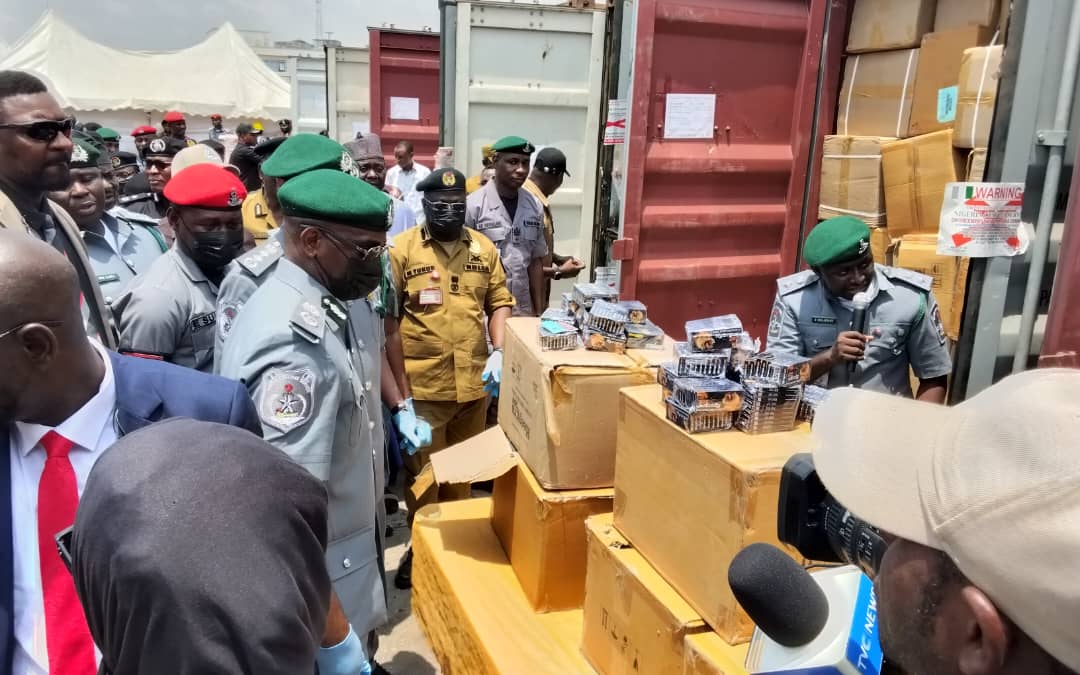
The Nigeria Customs Service (NCS) has delivered a major blow to illicit trade networks with the interception of 13 containers loaded with prohibited and falsely declared goods valued at over ₦6.38 billion at the Apapa Port in Lagos. The seizures, which include expired pharmaceuticals, unregistered drugs, codeine-based products, cannabis, and other contraband items, underscore Customs’ renewed push to protect public health while safeguarding Nigeria’s trade system from criminal exploitation.
Unveiling the seizures at the PMT Container Terminal, Apapa Command, the Comptroller-General of Customs (CGC), Bashir Adewale Adeniyi MFR, said the Service remains committed to facilitating legitimate trade while ensuring that the nation’s ports are not used as gateways for dangerous and illegal imports.
The CGC noted that with the growing volume of cargo passing through Nigeria’s seaports daily, the responsibility on Customs officers has become even greater.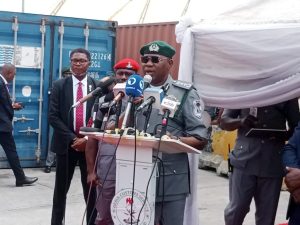
His words.
“Thousands of containers pass through this port every day carrying goods that sustain industries, support businesses and drive our national economy. While our mandate requires us to facilitate legitimate trade, we must also ensure that our ports are not exploited by criminal networks attempting to introduce dangerous, prohibited or falsely declared goods into the country”.
The Customs boss explained that the seizures were made possible through enhanced intelligence gathering and the deployment of technology-driven cargo inspection tools, particularly the Non-Intrusive Inspection (NII) scanning system. 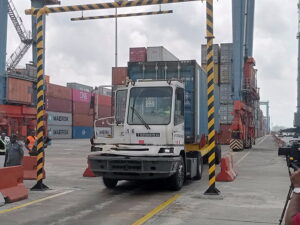
According to him, operational data from Apapa Port shows that 3,236 consignments were processed through the Orange Channel (scanning), 5,490 through the Yellow Channel (documentary checks), while 21,373 consignments underwent full physical examination under the Red Channel. Additionally, 1,118 consignments passed through the Blue Channel and 149 through the Green Channel, reflecting different levels of cargo facilitation based on compliance and risk profiling.
Adeniyi observed that the heavy reliance on physical examination highlights the urgent need to expand scanning technology across Nigeria’s ports.
“Our strategic objective is to significantly increase the proportion of cargo subjected to scanning across all major entry points before the end of the year. This includes Apapa, Tin Can Island, Port Harcourt, Onne and Calabar ports,”he said.
Going further he explained that strengthening non-intrusive inspection systems alongside intelligence-driven risk management would enable Customs to focus physical inspections on high-risk cargo while allowing compliant traders to enjoy faster cargo clearance.
Through targeted enforcement and risk profiling, Customs officers identified several containers with suspicious cargo declarations. Subsequent scanning and physical examination uncovered multiple consignments containing prohibited, expired and controlled substances.
Details of the seizures:
A 40-foot container (HASU 4072659) containing large quantities of expired pharmaceutical products including Mixagrip Cold Caplets, Ladinax tablets, Chloroquine injections and Diclofenac tablets.
Two 40-foot containers (MRSU 4584911 and MRSU 6913370) carrying Hyegra 200 and Sildenafil Citrate — unregistered pharmaceutical products.
A 20-foot container (MRKU 8830266) containing 800 cartons of codeine
(TPL CSC) concealed inside toilet flushing cisterns and sanitary ware.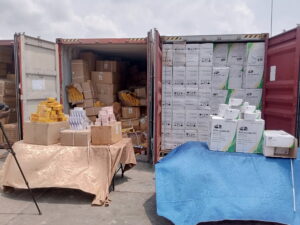
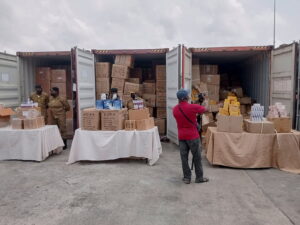
A 40-foot container (MRSU 5147562) conveying cartons of Artesunate 60 injections.
A 20-foot container (PCIU 286888) loaded with restricted security equipment, including bulletproof vests, helmets, walkie-talkies and tactical torches imported without End User Certificates.
Other intercepted consignments included expired food and beverages such as muffin cookie biscuits, 36,000 cans of Primo energy drinks, and expired tomato paste brands including St. Kelvin and De Truth.
Customs officers also uncovered 1,700 cartons of codeine cough syrup concealed inside luxury food flasks, as well as 1,575 cartons of CSMIX with codeine hidden with electric kettles.
In another operation, officers intercepted 13 jumbo bags of Cannabis Sativa (Colorado) weighing 347.57 kilograms, concealed inside a Toyota Sienna vehicle.
In all, the seized items are valued at ₦6,381,237,988, representing one of the largest contraband interceptions recorded at the Apapa Command in recent times.
The CGC warned that the importation of expired drugs and controlled substances poses a significant risk to Nigerians, stressing that such products can undermine the healthcare system and fuel substance abuse.
He said.
“The concealment of codeine-based products represents a deliberate attempt to promote substance abuse and endanger public health”.
Adeniyi declared that under the Nigeria Customs Service Act, 2023, the seized consignments are liable to forfeiture, while those connected to the illegal shipments will face prosecution.
“Apapa Port is no longer a playground for smugglers or criminal syndicates hiding behind legitimate trade documentation. Anyone attempting to undermine our trade system will be intercepted, exposed and prosecuted,” Adeniyi warned.
Adeniyi also commissioned the CGC Bashir Adewale Adeniyi Analytical Arena, a newly constructed two-storey facility at the Apapa Command designed to strengthen intelligence-driven customs operations.
Speaking at the event, the Area Controller of Apapa Command, Comptroller Emmanuel Oshoba, said the facility represents a major step forward in modernizing Customs enforcement operations.
According to Comptroller Oshoba, the centre houses the Command’s Analytics Centre of Excellence, the Customs Intelligence Unit (CIU), a clinic for officers, and other key operational offices, all designed to support data-driven border security and improve staff welfare.
He described the project as a product of the Customs-PACT (Partnership for Cooperation in Trade) initiative championed by the CGC, adding that the support of stakeholders made the project possible.
Comptroller Oshoba commended Adeniyi’s leadership and dedication to improving operational efficiency within the Service, noting that naming the building after the CGC reflects the respect and inspiration he has provided to officers across commands.
Commissioning the facility, CGC Adeniyi described the Apapa Command as a strategic hub of Customs operations, leading in revenue generation, trade facilitation and enforcement activities.
He noted that the new analytical centre would strengthen intelligence gathering and enhance the Service’s ability to detect high-risk consignments before they enter the country.
“Our enforcement is not against legitimate trade. It is against criminality. Compliant traders will continue to enjoy faster and more predictable cargo clearance, while those attempting to exploit the system will face the full weight of the law,” he said.